 how-to
How to Handle Damaged Art Deliveries: A Step-by-Step Guide
Table of Contents
- What to Do When Artwork Arrives Damaged: First Steps
- Damaged Art Delivery Photo Documentation That Holds Up
- How to Report Damaged Artwork in Shipping
- Filing a Shipping Damage Claim for Artwork
- Who Is Responsible: Buyer, Seller, or Carrier?
- Should You Repair, Restore, or Replace?
- Frequently Asked Questions
Last Updated: October 21, 2026
What to Do When Artwork Arrives Damaged: First Steps
How you handle the first ten minutes of damaged art deliveries decides whether you get a replacement, a refund, or nothing at all. At Miramontes Gallery, we ship fine art every week, and we have seen claims fall apart when a recipient tosses the packaging before taking a single photo.
The single most important rule: do not sign for the shipment until you have looked at the box. A signature is often the carrier's proof that the item arrived in good condition.
Inspect Before You Sign
Most carriers treat a clean signature as acceptance of the shipment's condition, and reversing that later is an uphill fight.
Follow this order:
- Look at the outside of the box before you touch the pen.
- Check for crush marks, punctures, water stains, or a box that sits at an odd angle.
- Shake it gently. If something shifts or rattles inside, note it.
- Write "damaged" or "possible damage" next to your signature if you see anything wrong.
- Ask the driver to stay while you open the outer layer, if the carrier allows it.
If the driver will not wait, sign with a note and photograph the box on the spot. A signature marked "subject to inspection" is far stronger than a clean one.
Safe Handling and Storage Before Assessment
Do not pull the painting out by the frame. Canvas and glazing are fragile, and a small tear can become a large one in seconds.
Move the shipment to a clean, dry, flat surface, keep large pieces upright, and never rest a canvas face-down on a hard floor.
- Wear clean cotton gloves if you have them.
- Lift from the bottom of the frame, never the top edge.
- Keep the piece away from direct sun, heat, and damp basements.
Store it flat and stable until you have documented everything. Rushing this step is how minor damage becomes total loss.
Damaged Art Delivery Photo Documentation That Holds Up
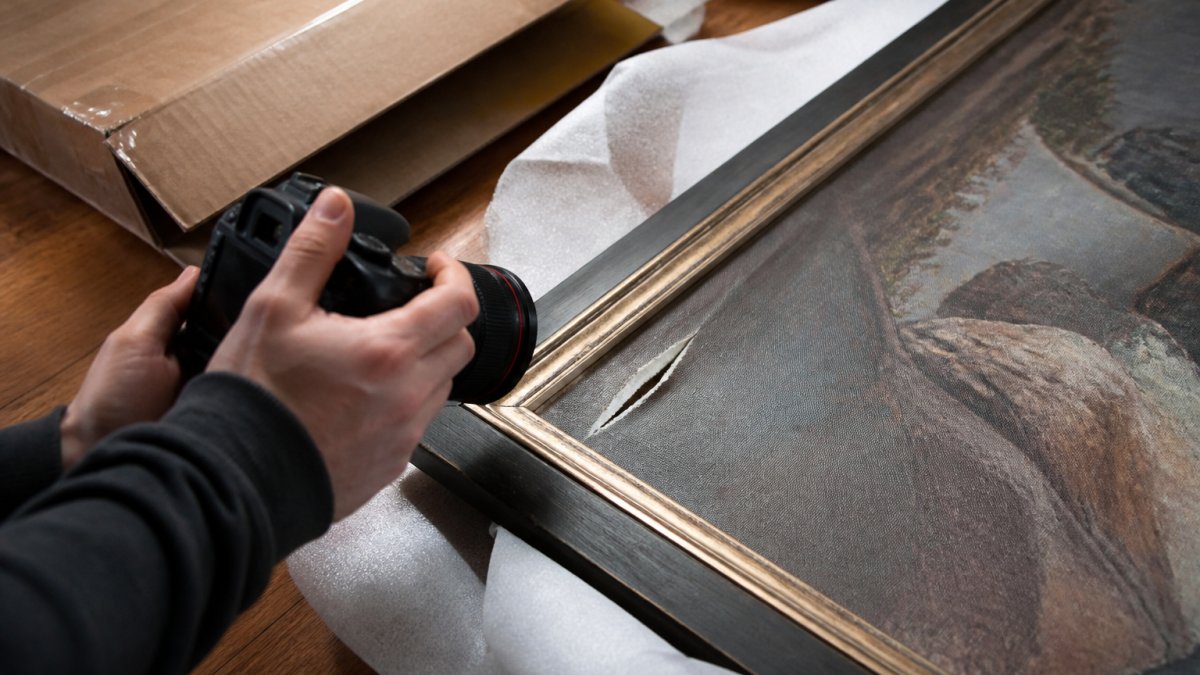
Damaged art delivery photo documentation is the evidence file that decides your claim. Carriers and sellers pay on images that show the damage, the packaging, and the piece together, not on description alone.
What to Photograph and In What Order
Shoot in this sequence so the story is clear:
- The box, before opening. All six sides, plus any labels and tracking numbers.
- The damage on the box. Close-ups of dents, punctures, and water marks.
- The packaging layers. Show the foam, corner protectors, and inner wrap as you remove them.
- The artwork in full. One clean shot of the entire piece.
- The damage itself. Close-ups from two angles, with a ruler or coin for scale.
- The frame and glazing. Cracks, chips, and loose corners.
- A wide shot. The piece next to the box, so the connection is obvious.
Keep every image in one backed-up folder; you will likely send the same set to the seller, the carrier, and the insurer.
How to Report Damaged Artwork in Shipping
Report the damage the same day it arrives. Speed matters more than perfect wording.
Here is how to report damaged artwork in shipping without leaving gaps:
- Contact the seller first. Send a short email with your order number and the photo set attached.
- Contact the carrier next. File a damage notice through their claims portal or phone line.
- Keep a written record. Save every email, reference number, and name you speak with.
A simple report template works well:
Subject: Damage Report, Order #[number]
Hello, my shipment arrived on [date] with visible damage to the outer box. The [painting/print] inside has [describe damage]. I have attached [number] photos showing the box, packaging, and artwork. I am requesting [replacement/refund/repair assessment]. Please confirm receipt and next steps.
Send it in writing every time. A phone call is fine to follow up, but the paper trail is what wins.
Filing a Shipping Damage Claim for Artwork
A shipping damage claim for artwork follows the rules of whoever is paying, not your preferences. There is no single national claim form and no universal deadline: the carrier, the seller's terms of sale, and any marketplace can each set different procedures and time limits, and the strictest one usually controls. Start the same day the damage is discovered and treat the first 24 hours as evidence-gathering time, not negotiation time.
Why Claim Rules Differ by Carrier, Seller, and Marketplace
Three separate processes can run at once, and they are not interchangeable:
- The carrier claim. A cargo or parcel damage claim filed with the company that moved the shipment, governed by that carrier's tariff and claim policy, which sets its own notice window, required forms, and inspection process. Some carriers require notice within days of delivery; others measure from the ship date. Check the policy tied to your tracking number rather than relying on a general rule.
- The seller resolution. A request to the gallery, dealer, or artist for a replacement, refund, or repair contribution, governed by the seller's return and damage policy and the terms of sale, not the carrier's tariff. Many sellers resolve damage issues directly and then pursue the carrier themselves, which is often faster for the buyer.
- The marketplace process. If the purchase ran through an online marketplace or payment platform, that platform may have its own dispute window and evidence requirements on top of the other two. Missing the platform window can close off a remedy even when the carrier claim is still open.
A practical rule: file with the carrier and notify the seller in writing the same day, since neither replaces the other.
Evidence and Information Checklist
Gather this before you file; a claim submitted without it usually comes back as a request for more information and burns days off the deadline:
| Item | Why the claim reviewer wants it |
|---|---|
| Photos of all six sides of the box before opening | Shows the condition at handoff |
| Close-ups of dents, punctures, crush marks, and water stains | Ties the damage to transit |
| Photos of each packaging layer as removed | Shows whether packing was adequate |
| Full view of the artwork plus close-ups of the damage from two angles | Establishes the extent of loss |
| A scale reference in at least one damage photo | Supports the description |
| Original invoice, order confirmation, or receipt | Establishes purchase price and declared value |
| Tracking number and delivery confirmation | Proves the shipment was in the carrier's care |
| The delivery receipt or signature record, including any damage notation | Shows condition at handoff |
| A dated written damage report sent to seller and carrier | Creates the paper trail |
| Repair estimate or conservator assessment, if you have one | Supports the compensation amount |
Keep the originals and send copies, and save every email, reference number, and name. If a phone call resolves something, follow up with an email summarizing what was agreed.
Carrier Claim vs. Seller Resolution
These two paths ask different questions. A carrier claim asks whether the shipment was damaged while the carrier was responsible, and pays according to the declared value and the carrier's liability terms.
In practice, the fastest path is often to let the seller lead while you preserve the carrier claim in parallel.
Review the shipping insurance and declared value before you file. For your rights when a seller ships damaged goods, see the U.S. Federal Trade Commission guidance on mail, internet, and telephone order rules.
Who Is Responsible: Buyer, Seller, or Carrier?
Responsibility depends on who held the risk at the moment of damage, decided by the terms of sale, the carrier's liability rules, and the facts of the handoff. In most online art sales the seller or carrier carries the risk until delivery is complete, but the details live in the terms of sale and shipping documents. The goal is not to win an argument about fault but to get one party to commit in writing to a remedy while keeping the others informed.
The Three Parties and What Each One Controls
- Seller. Controls packing, the terms of sale, the return and damage policy, and whether to replace, refund, or contribute to repair. Generally responsible if the piece was packed poorly or was already damaged before shipping.
- Carrier. Controls the transit and the claim process. Generally responsible if the box shows transit damage and the claim is filed within its notice window with the required evidence.
- Buyer. Controls the inspection at delivery, the documentation, and the speed of notice. Generally responsible only if the damage happened after a clean, signed delivery with no notation, or if the buyer discarded the packaging and evidence.
A common mistake is assuming the buyer eats the loss; a documented claim usually shifts the cost back to the seller or carrier, but only if the evidence survives the first day.
What to Request in Writing, and From Whom
Send one email to the seller and a separate notice to the carrier, then keep both threads alive. Ask for these commitments in writing:
- From the seller: confirmation that the damage report was received, the remedy they are offering (replacement, refund, or repair contribution), who is responsible for return shipping, and whether they will file the carrier claim themselves.
- From the carrier: a claim reference number, the name of the assigned claims handler, the deadline for additional documentation, and whether an inspection will be scheduled.
- From both: confirmation of who will arrange and pay for any inspection, and where the piece should be stored in the meantime.
A short written request works better than a long complaint:
Please confirm in writing: (1) that you received the attached damage report and photos, (2) the remedy you are offering, (3) who is responsible for return shipping, and (4) whether you will file the carrier claim or whether I should. I am holding the packaging and the artwork as received pending your instructions.
Coordinating Inspection, Return, Repair, or Replacement
When responsibility is disputed, whoever controls the next physical step controls the timeline. Keep these rules:
- Do not return the piece until you have written instructions. A return shipped before the seller confirms receipt of the claim can complicate both the carrier claim and the seller resolution.
- Do not authorize repair before the responsible party agrees in writing to cover it. A repair performed first can reduce or void the claim.
- Ask who schedules the inspection. Some carriers send an inspector; some ask for photos and an estimate instead. Get the method and the deadline in writing.
How Declared Value and Insurance Change Who Pays
Declared value and shipping insurance decide the size of the carrier payout, not the seller's obligation. If the piece was insured for less than its purchase price, the carrier may pay only up to the declared amount, and the difference becomes a seller conversation under the terms of sale.
At Miramontes Gallery, our return policy includes no-charge replacement or refund for quality issues, and we ask buyers to send photos right away so we can start the process fast and coordinate the carrier claim on the buyer's behalf.
Should You Repair, Restore, or Replace?
Not every damaged piece should be repaired. The right choice depends on the damage type and the value of the work.
- Minor frame damage: A local framer can often replace or repair the frame without touching the art.
- Torn canvas: Needs a professional conservator. Do not tape or glue it yourself.
- Cracked glazing: Replace the glass or acrylic, and check the art underneath for scratches.
If the damage is covered, take the replacement. If the piece is one of a kind and repairable, a conservator is worth the cost. Ask the seller which option they will cover before you authorize any work.
Damaged art deliveries feel like a disaster, but they are solvable when you act in order: inspect before signing, photograph everything, report the same day, and file within the deadline. Miramontes Gallery ships with secure, SSL-encrypted checkout and a clear return policy that includes no-charge replacement or refund for quality issues.
Frequently Asked Questions
What should I do first if art arrives damaged?
Do not sign for the delivery until you have inspected the outer packaging, and note any visible damage on the delivery receipt before the driver leaves. Once inside, unpack the artwork promptly and photograph the box, packing materials, and the piece itself before moving it. Keep every piece of original packaging. Then contact the seller or gallery within 24 to 48 hours with your photos so they can begin a shipping damage claim for artwork while the evidence is fresh.
How do I document damage to artwork delivered by mail?
Damaged art delivery photo documentation should capture the whole story: the exterior of the box, any crushed corners or punctures, the inner protective packaging, and then the artwork from multiple angles. Take close-ups of tears, cracks in glazing, frame dents, and moisture stains, plus a wide shot showing the entire piece. Include a photo with a ruler or coin for scale. Save the original files with timestamps, and do not retouch or crop them, since carriers and insurers may ask for the unedited originals.
Should I keep the original packaging after art arrives damaged?
Yes. Keep the box, foam, corner protectors, glassine paper, and any inner crating exactly as they arrived. Carriers and insurers often require the original packaging for inspection, and the seller may need it to file a shipping damage claim for artwork. Store the materials flat and dry in a garage or closet until the claim is resolved, which can take several weeks. Throwing the packaging away early is one of the most common reasons claims get denied.
Can I repair damaged artwork before filing a shipping claim?
Do not attempt repairs before the claim is settled. Any alteration, touch-up, or reframing can void coverage and make it harder to prove the original damage. Leave the piece as delivered, store it flat and away from moisture, and wait for the carrier or insurer to authorize next steps. If restoration is approved, work with a qualified conservator rather than a general framer, and keep all receipts, since those costs may be reimbursable under the claim.