 comparison
AIArtShop Alternative: 5 Art Marketplaces Compared (2026)
Table of Contents
- AIArtShop Alternative: What Buyers and Sellers Should Compare First
- The Major Online Art Marketplaces at a Glance
- Redbubble: The Print-on-Demand Volume Play
- Zazzle and Society6: Custom Products and Curated Home Goods
- Etsy: The Largest Marketplace for Original Art Online (With Caveats)
- How to Visualize Art in a Room Before You Buy
- Augmented Reality Art Preview: What It Does and Where It Falls Short
- AI Content Policies, Copyright, and Licensing by Platform
- Frequently Asked Questions
Last Updated: October 19, 2026
AIArtShop Alternative: What Buyers and Sellers Should Compare First
Hunting for an AIArtShop alternative usually starts with one of two frustrations: buyers who want artwork they can trust, or sellers who want a marketplace that pays them fairly.
An online art marketplace is a third-party platform where many independent sellers list work and the platform handles discovery, checkout, and often fulfillment. That model is convenient, but your buying experience depends on a seller you have never met.
Buyer checklist: fees, fulfillment, and returns
Before you commit to any marketplace, run through these checks:
- Total landed cost: item price plus shipping, framing, and any handling fees.
- Fulfillment model: does the platform print and ship, or does an individual seller?
- Preview tools: can you see the piece to scale in your space before buying?
Seller checklist: commissions, payout timing, and AI disclosure
For creators, the questions shift:
- Commission structure: what percentage does the platform keep per sale?
- Payout timing: when do you actually get paid, and what is the minimum threshold?
- AI disclosure rules: does the platform require you to label AI-generated work?
The Major Online Art Marketplaces at a Glance
The market splits into two camps: print-on-demand platforms that mass-produce your design onto products, and curated galleries that sell original or limited work. The details that actually decide whether a platform works for you are fees, payout timing, AI-content rules, and who controls fulfillment.
Side-by-side comparison table
| Platform | Model | Best For | Buyer Trust Signals | Seller Notes | Fee & Payout Snapshot | AI-Content Stance (verify before listing) |
|---|---|---|---|---|---|---|
| Miramontes Gallery | Curated fine art gallery | Collectors wanting verified, culturally-inspired work | SSL-secured checkout, no-charge quality replacements, AR preview | Direct gallery relationship | Pricing depends on quantity, dates, and delivery; see website for current prices. | Human-made, culturally-inspired work; provenance stated per piece |
| Redbubble | Print-on-demand | High-volume product sales | Platform-managed fulfillment | Design uploaded to many products | Artist margin set per product; platform pays out on a threshold schedule | Historically permissive toward uploaded designs; disclosure expectations have tightened, check current artist agreement |
| Zazzle | Print-on-demand + custom | Customizable products | Established brand | Broad product catalog | Royalty percentage set by seller within platform bounds; volume tiers apply | Case-by-case review; some AI-assisted designs allowed with restrictions |
| Society6 | Print-on-demand home goods | Curated home decor | Curated storefronts | Design-driven listings | Flat artist percentage per sale; payout threshold applies | Mixed; curation review can reject mass-generated uploads |
| Etsy | Open marketplace | Original and handmade art | Seller reviews, buyer protection | You manage your own shop | Listing fee per item plus transaction percentage plus payment processing | Requires disclosure of AI use in some categories; enforcement varies by shop |
How to read the fee column without getting burned
A marketplace's headline commission is rarely the whole cost. The real number is what lands in your account after listing fees, payment processing, currency conversion, and any promotional spend. Model three scenarios, a $25 sale, a $75 sale, and a $200 sale, because flat fees hurt small sales disproportionately while percentage fees scale with price. Also note the payout threshold: some platforms hold earnings until you clear a minimum.
How to read the AI-content column
AI policy is where these platforms diverge most. Some require you to label AI-generated or AI-assisted work at upload; others restrict AI in certain categories; many say little and enforce inconsistently. For buyers, the question is provenance, human-made, AI-assisted, or fully generated? For sellers, it is liability, can you license the work commercially, and what happens if a buyer disputes it?
If you sell on more than one platform, keep a simple spreadsheet with columns for commission, listing fee, payment processing, payout threshold, AI-disclosure requirement, and commercial-license terms. Update it when a platform emails a policy change. That one habit prevents most unpleasant surprises.
Which platform fits which goal
- Independent artists building a brand: a curated gallery or your own storefront, where you keep the customer relationship and can set prices.
- Print sellers chasing volume: a print-on-demand platform, accepting lower per-unit margins in exchange for reach and no inventory risk.
- Collectors wanting provenance: a curated gallery with stated authorship and a real return policy, not an open marketplace where vetting is on you.
The table above is a starting point, not a verdict. The right platform depends on whether you are buying or selling, how much control you want, and how much fee drag your margins can absorb.
Redbubble: The Print-on-Demand Volume Play
Redbubble is a print-on-demand platform where you upload one design and it appears on t-shirts, stickers, mugs, and prints, with Redbubble handling production and shipping, appealing for sellers who want reach without managing inventory.
The catch is control. You are one listing among millions, so discoverability depends on the platform's algorithm. And because the same design lands on dozens of products, the "art" often feels secondary to the merchandise.
If you sell on a print-on-demand platform, treat your best design as a portfolio piece, not a product. Link buyers back to a place where they can see your full body of work.
Zazzle and Society6: Custom Products and Curated Home Goods
Zazzle offers customization where buyers can tweak a design onto a specific product. Society6 focuses on curated home goods, with storefronts that feel more like a gallery than a warehouse.
Both are options for creators who want product variety without building a store. However, the emphasis is on decor and merchandise, so a buyer hunting for an original painting or signed photograph may not find the depth or provenance they want.
- Zazzle: strongest for personalized, made-to-order products.
- Society6: strongest for design-led home decor with a curated feel.
Etsy: The Largest Marketplace for Original Art Online (With Caveats)
Etsy is an open marketplace for original art online, and its scale offers both advantages and disadvantages. Buyers get a large selection and seller reviews; sellers get built-in traffic and their own shop.
The caveats matter. Because anyone can open a shop, quality can vary, and buyers often need to do their own vetting. For sellers, competition can be fierce, and fees stack up across listings and transactions.
How to Visualize Art in a Room Before You Buy
Knowing how to visualize art in a room is the difference between a confident purchase and a costly return. Colors shift under different lighting, and a piece that looks right in a photo can overwhelm a wall in person.
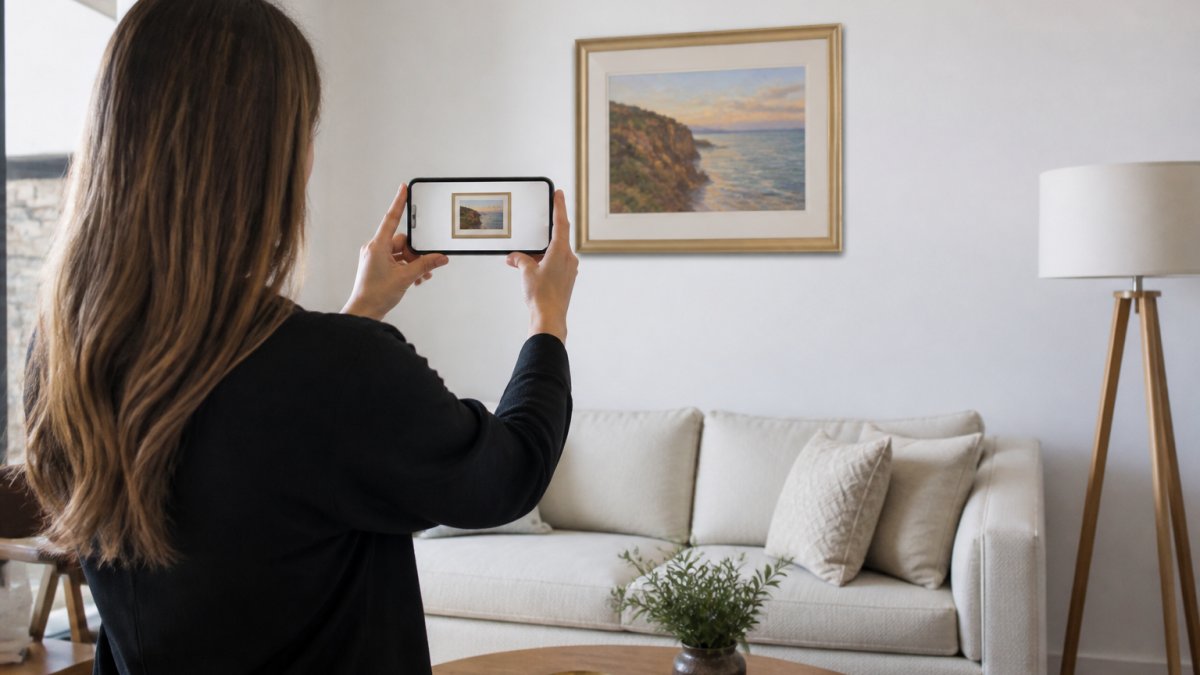
Here is a simple process we recommend:
- Measure your wall and note the furniture below it.
- Photograph the wall in daylight and again in the evening.
- Use a preview tool to place the piece to scale.
- Check the frame color against your existing fixtures.
- Sit with the preview for a day before buying.
This is exactly where an augmented reality art preview earns its keep. At Miramontes Gallery, our AR tool lets you see a piece in your own space before checkout, so you are not guessing from a thumbnail.
Augmented Reality Art Preview: What It Does and Where It Falls Short
An augmented reality art preview overlays a piece onto a live camera view of your wall, showing scale and placement in real time, the closest thing to standing in a gallery without leaving home.
Where it falls short: AR cannot perfectly replicate how a surface reflects light, and screen calibration varies by device. Treat AR as a strong guide, not a guarantee.
AI Content Policies, Copyright, and Licensing by Platform
AI content policy is the wild west of art marketplaces right now, but 'wild west' is not a buying or selling strategy. What matters is narrower: what each platform requires you to disclose, what rights you grant when you upload or buy, and who bears the risk if a claim arises. Here are the four questions that decide the outcome.
1. Disclosure: what must be labeled, and to whom
Disclosure requirements vary by platform and category. A common pattern is a checkbox or metadata field at upload asking whether the work is AI-generated, AI-assisted, or human-made. Some platforms restrict AI-generated work in specific categories while allowing it elsewhere, and enforcement is inconsistent, so buyers should not assume a listing's silence means human-made. Sellers should disclose at upload and keep a record; if a dispute arises, that record is your defense.
2. Copyright: who owns what
Copyright in AI-generated images is unsettled in the United States. The U.S. Copyright Office has generally required human authorship for registration, a fully AI-generated image may not be registrable, while a work with meaningful human authorship may be. This is not legal advice; consult an attorney for anything commercially significant. The practical takeaway: do not assume that because you prompted an image, you hold enforceable copyright in it, and that uncertainty flows into what you can license to a buyer.
3. Licensing: what the buyer actually gets
A purchase on a marketplace is not automatically a transfer of copyright. Most platforms sell a license, often limited to personal use, sometimes extended to commercial use for a fee, while the seller retains copyright (or, in the AI case, whatever rights exist). Buyers should check whether commercial use is permitted, whether resale is allowed, and whether the license survives if the platform changes its terms.
4. Training data and provenance risk
A quieter risk sits upstream: whether the model that produced an image was trained on copyrighted work, and whether that exposes the seller or buyer to a claim. This is actively litigated and unresolved. Buyers who need clean provenance should ask sellers to state the tool and process used, and prefer galleries that stand behind authorship in writing. Sellers should keep records of their tools and workflows, because 'I do not know how it was made' is not a defense.
None of the above is legal advice, and platform terms change without much notice. Before you list AI-assisted work or buy it for commercial use, read the current seller agreement and licensing page, and get professional counsel if the stakes are meaningful. A $40 print and a $4,000 campaign asset carry very different risk.
A buyer's and seller's quick rule set
- Buyers: confirm the license scope (personal vs. commercial), confirm resale rights, and ask for provenance in writing when it matters.
- Sellers: disclose AI use at upload, keep records of tools and process, and read the license you grant the platform before you click publish.
- Both: treat 'human-made' as a claim that should be verifiable, not a vibe.
Our advice: read the AI disclosure and licensing terms before you list or buy, and when provenance matters, buy from a gallery that stands behind its work. Miramontes Gallery offers culturally-inspired fine art with a transparent, SSL-secured buying process and no-charge replacements for quality issues.
Frequently Asked Questions
Can you legally sell AI-generated art in the U.S.?
Yes, you can sell AI-generated art in the U.S., but copyright protection is limited. The U.S. Copyright Office has said that works lacking human authorship cannot be registered, so purely AI-generated images may not be protectable. That does not stop you from selling them, but it does affect how you enforce exclusivity. Platforms like Redbubble, Zazzle, Society6, and Etsy each set their own AI disclosure rules, so check the current policy before you upload. Keep records of your prompts and any human edits.
What should I compare when choosing an online art marketplace?
Compare four things: total seller fees (listing, transaction, and payment processing), payout timing, AI-content policy and disclosure requirements, and fulfillment responsibility. On the buyer side, check return windows, who pays return shipping, and whether the platform handles replacements for damage. Read the fee schedule line by line because base prices and commission structures differ widely. Also confirm whether the platform supports the format you want, such as canvas prints, framed wall art, or digital downloads.
Where can I buy original art online without worrying about AI-generated pieces?
Look for platforms that require artist verification, disclose AI use, or focus on original, one-of-a-kind works. Gallery-style sites and artist-run storefronts typically document provenance, medium, and edition size. Ask the seller directly whether the piece is original, a reproduction, or AI-assisted, and request a condition report and detailed photos. On larger marketplaces, filter by handmade or original categories and read the listing description closely. A clear return policy is your best safety net.
How accurate is an augmented reality art preview?
AR previews are useful for scale and placement, not for exact color matching. Most phone-based AR tools render a piece at true size on your wall, which helps you judge whether a 24-by-36-inch canvas overwhelms a space. Color accuracy depends on your screen calibration and the lighting in your room, so expect some variation from the actual piece. Use AR to rule out sizes and layouts, then request additional photos in natural light before you commit to a purchase.
What fees do art marketplaces charge sellers?
Fee structures vary by platform and change over time. Most marketplaces take a percentage commission on each sale, and some add listing fees, payment processing fees, or subscription tiers. Print-on-demand platforms typically build production and shipping costs into a base price, and you set a markup on top. Because rates change, confirm the current fee schedule on each platform before you list. Model your net payout on a sample sale rather than assuming a headline percentage.
Choosing an AIArtShop alternative comes down to what you value: volume and convenience, or provenance and trust. If you are a collector who wants to see a piece in your space before you commit, Miramontes Gallery pairs an augmented reality preview with secure checkout and a no-charge replacement policy for quality issues. Browse our collection and shop art with the confidence of seeing it on your own wall first.